When budgets are tight and new GPU deployments face long procurement lead times, launching an AI service cannot always begin with buying more hardware. For universities, national labs, and research-driven organizations, the starting point may already be in the data center.
Many of these organizations operate powerful GPUs in Slurm clusters. The opportunity is to make that infrastructure available through AI services that researchers, students, staff, and enterprise applications can use.
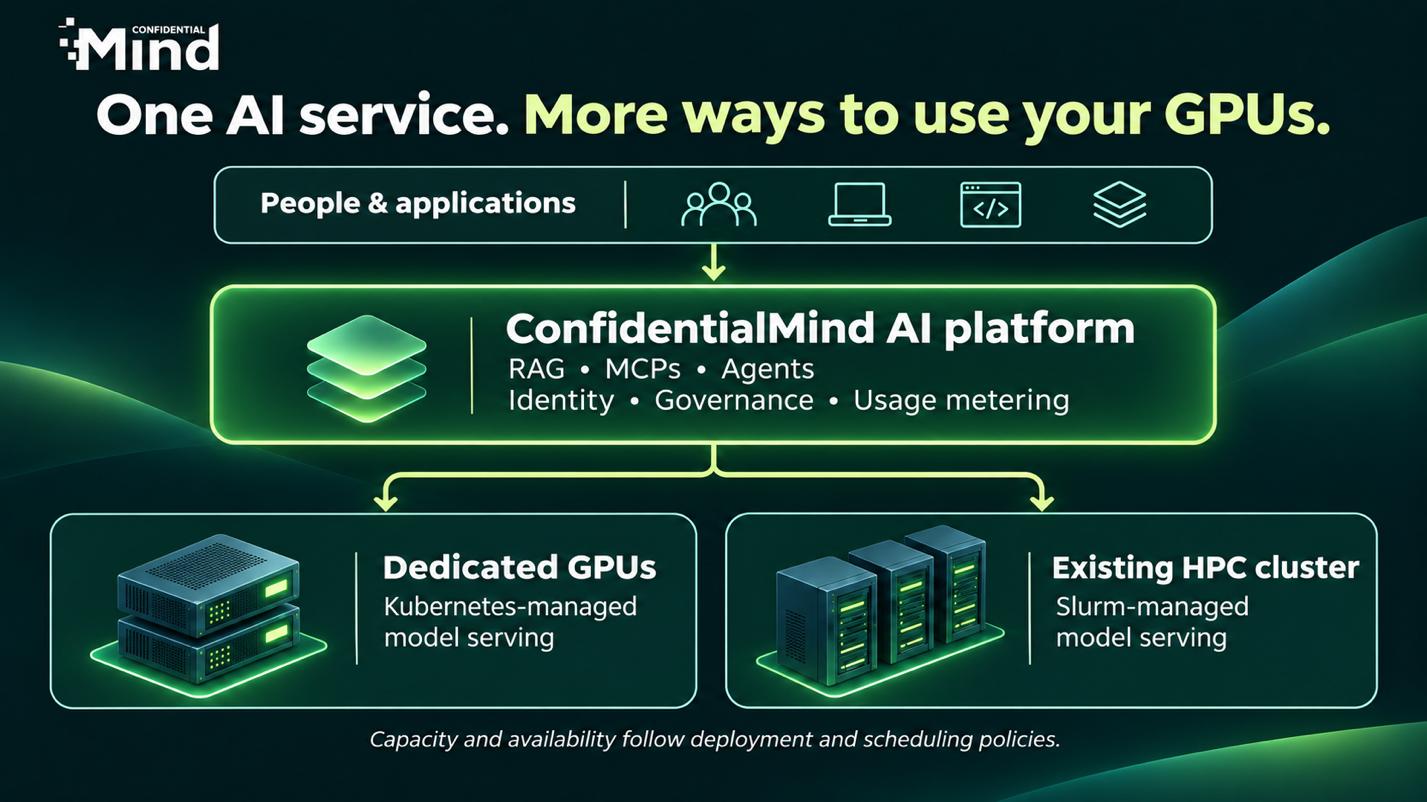
At SC26, we are announcing Slurm support in ConfidentialMind. Organizations can deploy models onto connected Slurm clusters and use them through the same AI platform that supports their dedicated GPU deployments.
The models run where the GPUs already live. Users get the platform capabilities they need to put them to work.
The full platform across two deployment paths
ConfidentialMind deploys model serving as a long-running Slurm job, with requests routed through the platform. Identity, authorization, tenant controls, observability, and usage metering remain in place, alongside retrieval, agents, chat, and output guardrails.
This gives teams a consistent foundation for building and operating AI services, whether the models run on Slurm-managed capacity or dedicated GPUs managed through Kubernetes.
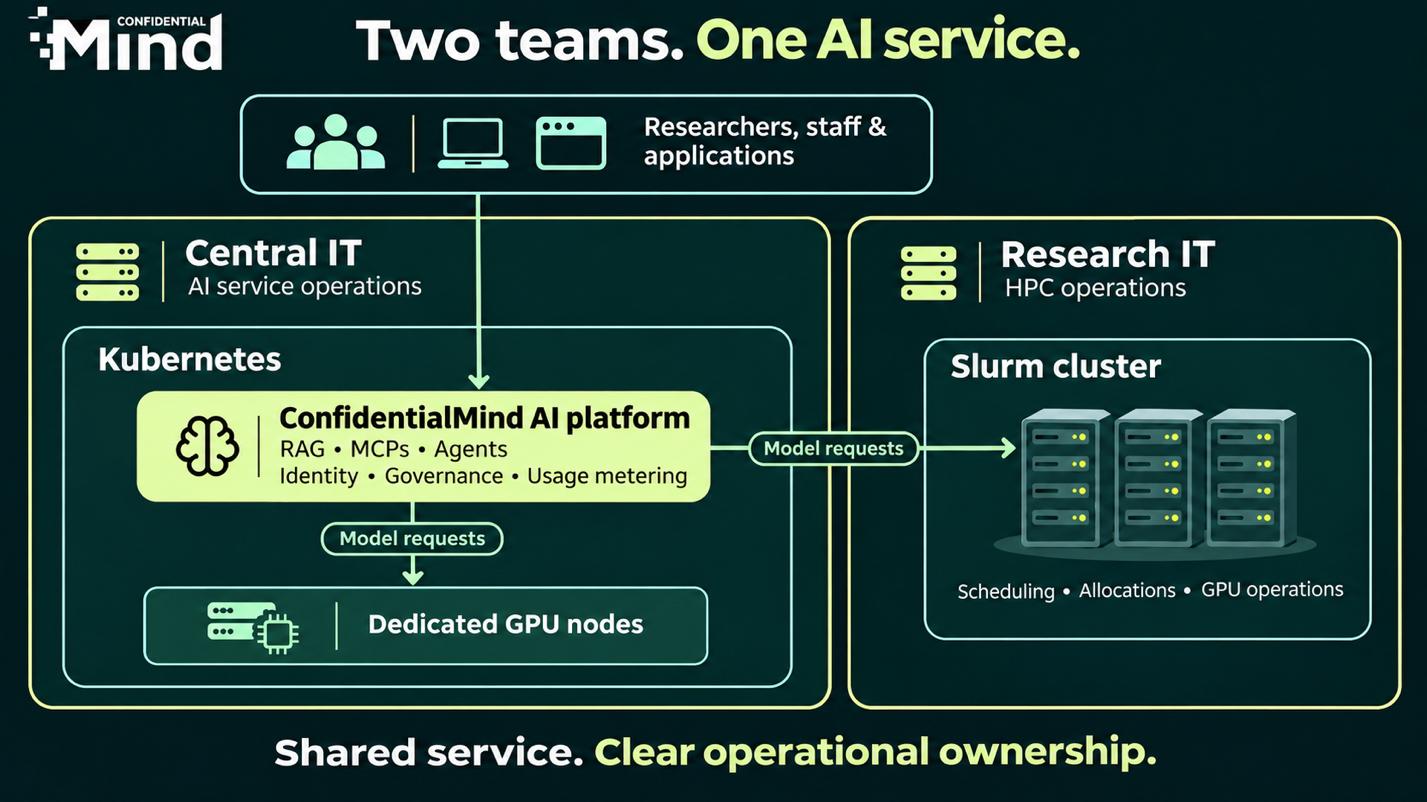
Research IT can continue operating the HPC cluster through Slurm. Central IT can manage the ConfidentialMind platform and dedicated nodes through Kubernetes. Applications and users access their AI services through the same platform.
From individual deployments to a shared service
Researchers already deploy their own inference engines on HPC clusters. That gives them the access they need, but it can also leave each deployment serving just one person or project.
When several researchers independently deploy the same model, the cluster can hold multiple copies of its weights and reserve GPU resources for services that receive only occasional requests. Allocated capacity does not necessarily mean useful utilization. Part of this poorly allocated capacity could be running other jobs from the queue improving OPEX.
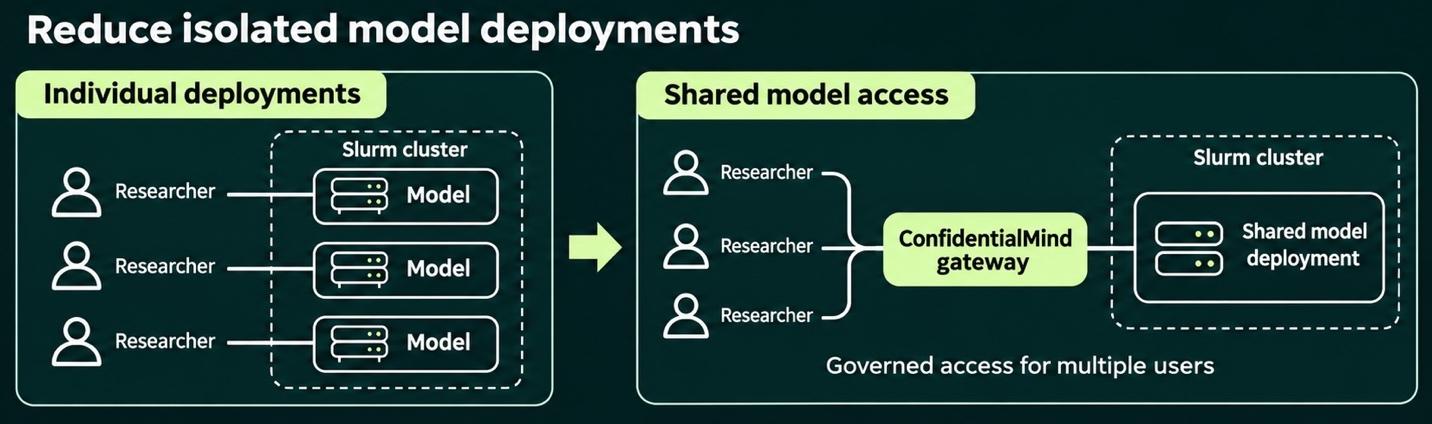
A shared AI service offers a substantially efficient alternative. Where requirements align, multiple users and projects can access a common model deployment, with authorization, tenant controls, and usage attribution managed by the platform.
Researchers gain access without each having to operate an inference engine. HPC teams gain a way to reduce duplicated deployments and make model-serving capacity useful to a wider community.
Specialized experiments will still need their own deployments. This is supported through GPU-quotas and tenant specific deployments for each tenant on the platform.
Four reasons to connect inference to Slurm
1. Get more value from existing GPU capacity
Sharing model deployments can bring more demand to the same serving resources and reduce unnecessary duplication. Where cluster capacity is available or can be allocated, organizations can support AI services alongside existing research workloads.
HPC teams retain control over scheduling and resource allocation. ConfidentialMind provides the platform through which that capacity becomes a governed service for multiple users and departments.
The utilization benefit depends on the workload mix, but the objective is clear: better utilization and improved quality of service from the GPUs already installed.
2. Evaluate models and add capacity without a separate hardware purchase
A connected cluster gives teams somewhere to evaluate a candidate model, support a pilot, or provision additional inference capacity before committing to dedicated hardware.
A research group can benchmark a model against its own workloads. IT can prepare capacity for a course, an event, or a new departmental service. Those deployments use existing infrastructure, subject to available resources and scheduling policies.
This creates a shorter path from an idea to a working service—and better demand data for the next investment decision.
3. Support higher availability with a larger GPU pool
When inference relies on a single dedicated GPU node, a hardware failure can take the service offline. Connecting ConfidentialMind to a Slurm cluster provides access to a larger pool of GPUs, allowing model serving to resume on other available nodes instead of waiting for that machine to be repaired. This gives organizations more options for meeting their AI service availability requirements.
4. Keep your deployment options open
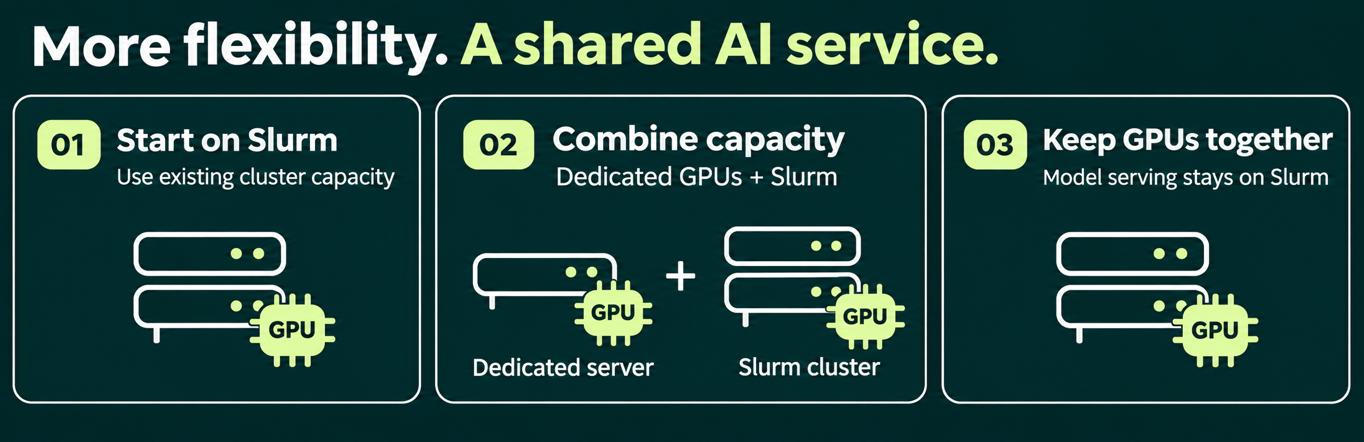
Start on existing Slurm capacity, combine it with dedicated GPUs as demand grows, or keep model serving within the HPC cluster.
The choice can follow your service requirements, investment plans, and approach to GPU ownership. ConfidentialMind supports a consistent platform experience across those arrangements.
Two teams serving their communities
Research IT and central IT both have users who need dependable AI services.
Research IT supports researchers who need models for scientific workflows, experimentation, and research applications. Central and enterprise IT support students, teaching, staff, and enterprise applications.
A shared platform lets both teams provide services suited to their communities while drawing on infrastructure managed by the people best equipped to operate it. This operating model can also reduce costs by making better use of existing infrastructure and avoiding the need for each team to build and maintain its own AI service.
In this operating model, Research IT manages the Slurm cluster, its allocations, and its scientific workloads. Central IT manages the ConfidentialMind platform and dedicated Kubernetes-based capacity. Together, they define service access, support responsibilities, capacity commitments, and recovery expectations.
This builds on the hybrid approach I have described for university AI services. Infrastructure ownership can stay clear while both teams expand what they offer their users.
Meet us at SC26 – booth 6815
Visit booth 6815 during the exhibition, November 16–19, to discuss shared model access, GPU utilization, and how your existing infrastructure could support your next AI service.
Your next AI service may begin with the GPUs you already own.